Crypto
Crypto
todo http://www.wuy4n.com/2025/11/29/ZJUCTF2025wp/
Crypto-it
给了私钥的 RSA,会读就行:
from Crypto.PublicKey import RSA
from Crypto.Cipher import PKCS1_OAEP

with open("private_key.pem", "rb") as f:
    key_data = f.read()
key = RSA.import_key(key_data)
print("[+] n  =", key.n)
print("[+] e  =", key.e)
print("[+] d  =", key.d)
with open("flag.enc", "rb") as f:
    ciphertext = f.read()
cipher_rsa = PKCS1_OAEP.new(key)
try:
    plaintext = cipher_rsa.decrypt(ciphertext)
    print("[+] Decrypted plaintext:")
    print(plaintext)
except ValueError as e:
    print("[-] 解密失败:", e)
random
在 _randomemodule.c 中可以发现,PRNG 在初始化时会将种子取绝对值:
static int
random_seed(RandomObject *self, PyObject *arg)
{
    // ...
    /* This algorithm relies on the number being unsigned.
     * So: if the arg is a PyLong, use its absolute value.
     * Otherwise use its hash value, cast to unsigned.
     */
    if (PyLong_CheckExact(arg)) {
        n = PyNumber_Absolute(arg);  // 关键:取绝对值
    } else if (PyLong_Check(arg)) {
        _randomstate *state = _randomstate_type(Py_TYPE(self));
        n = PyObject_CallOneArg(state->Long___abs__, arg);  // 同样
    }
    // ...
}
也即是说,x 与 -x 做种子,得到的 otp 相同,加密同一个 msg 得到的密文当然也相同;结合大端序编码 key = int.from_bytes(flag.encode(), 'big'),应该从右侧开始攻击,err 逐位尝试 0/1 并获得两个密文;如果相同,说明 key 的这一位为 0;否则为 1:
from pwn import *
import sys

def query_oracle(r, err):
    msg = b'\x00' * 64
    r.sendafter(b'input msg: ', msg.hex().encode())
    r.sendafter(b'input err: ', str(err).encode())
    r.recvuntil(b'encrypted:  ')
    response_hex = r.recvline().strip().decode()
    return bytes.fromhex(response_hex)

context.log_level = 'info'
r = remote("127.0.0.1", 2265)

recovered_int = 0
MAX_BITS = 512

for bit_idx in range(MAX_BITS):
    perturbation = 1 << bit_idx

    err_plus = recovered_int + perturbation
    err_minus = recovered_int - perturbation

    ct1 = query_oracle(r, err_plus)
    ct2 = query_oracle(r, err_minus)

    if ct1 is None or ct2 is None:
        print("Failed to get ciphertext.")
        break

    if ct1 != ct2:
        recovered_int |= perturbation

    if (bit_idx + 1) % 8 == 0:
        try:
            byte_len = (recovered_int.bit_length() + 7) // 8
            current_bytes = recovered_int.to_bytes(byte_len, 'big')

            if b'ZJUCTF{' in current_bytes:
                print(f"\nRecovering: {current_bytes}")
                if current_bytes.endswith(b'}'):
                    print(f"Flag found: {current_bytes.decode()}")
                    break
        except Exception as e:
            print(e)

    if bit_idx % 16 == 0:
         sys.stdout.write(f"\r[*] Progress: {bit_idx}/{MAX_BITS} bits recovered")
         sys.stdout.flush()
r.close()

print(f"\nRecovered Key: {recovered_int}")
byte_len = (recovered_int.bit_length() + 7) // 8
print(f"Flag: {recovered_int.to_bytes(byte_len, 'big')}")

ZJUCTF{3d16f6b5-6bac-4d53-a5c0-9ddd99ea56c8}
paillier
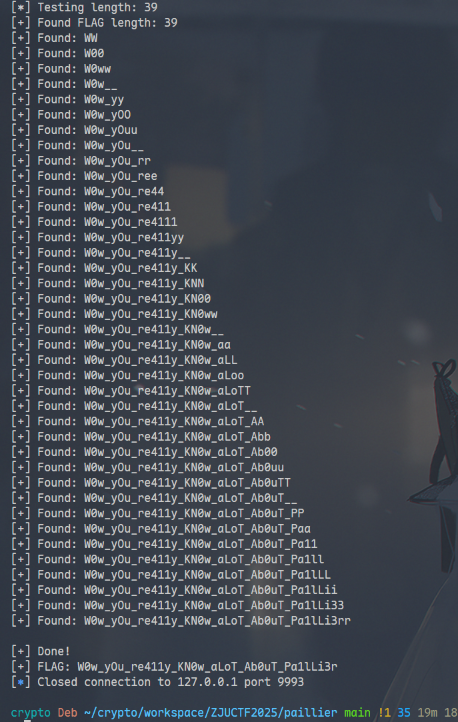
服务端提供四种字符串处理方式,核心判定是:如果 actions[action](long_to_bytes(paillier.decrypt(x))) == long_to_bytes(paillier.decrypt(y)),则通过。
- 考虑同态性质:Paillier 支持加法和数乘同态
- \(E(m_1) \cdot E(m_2) \equiv E(m_1 + m_2)\)
- \(E(m)^k \equiv E(k m)\)
- 爆破 FLAG 长度:利用 "CTRL-C + CTRL-V" 处理方式,构造密文使得处理后长度为 L,遍历 L 直到判定通过
- 逐字节爆破 FLAG:每次猜测一个前缀,构造密文使得去掉前缀后长度为剩余长度,判定通过则该字节正确
from pwn import *
from Crypto.Util.number import long_to_bytes, bytes_to_long

conn = remote("127.0.0.1", 9993)
conn.recvuntil(b"n = ")
n = int(conn.recvline().strip())
conn.recvuntil(b"you:  ")
C_flag = int(conn.recvline().strip())
n2 = n * n

def E_simple(m):
    """无随机性的Paillier加密"""
    return pow(n + 1, m, n2)

def homomorphic_add(C1, C2):
    """C_m1 * C_m2 -> m1 + m2"""
    return (C1 * C2) % n2

def homomorphic_mul(C, k):
    """C_m^k -> k * m"""
    return pow(C, k, n2)

def send_oracle(action, x, y):
    conn.recvuntil(b"homomorphism: ")
    conn.sendline(action.encode())
    conn.recvuntil(b"Parameters: ")
    conn.sendline(f"{x},{y}".encode())
    response = conn.recvline()
    return b"Good job" in response

def get_flag_length():
    L_flag = -1
    for L in range(10, 70):
        print(f"[*] Testing length: {L}")

        action = "CTRL-C + CTRL-V"
        x = C_flag
        # m_y = m_x * (256(L+2) + 256) + 45 * (256(2*L+2) + 256(L+1) + 1)
        k1 = pow(256, L + 2) + 256
        k2 = 45 * (pow(256, 2 * L + 2) + pow(256, L + 1) + 1)

        # C_y = C_flag^k1 * E_simple(k2)
        C_k1 = homomorphic_mul(C_flag, k1)
        C_k2 = E_simple(k2)
        y = homomorphic_add(C_k1, C_k2)
        if send_oracle(action, x, y):
            L_flag = L
            print(f"[+] Found FLAG length: {L_flag}")
            break

    return L_flag

# L_flag = get_flag_length()
L_flag = 39
known_prefix = b""
for i in range(L_flag):
    for g in range(32, 127):
        current_char = bytes([g])
        guess_prefix = known_prefix + current_char
        check_len = L_flag - len(guess_prefix)
        m_guess_num = bytes_to_long(guess_prefix) * pow(256, check_len)
        C_guess = E_simple(m_guess_num)
        C_sub = homomorphic_add(C_flag, pow(C_guess, n - 1, n2))
        if check_len == 0:
            if send_oracle("STAND STILL ONLY", C_sub, E_simple(0)):
                known_prefix += current_char
                print(f"\r[+] Found: {known_prefix.decode()}")
                break
        else:
            action = "CTRL-C + CTRL-V"
            x = C_sub
            k1 = pow(256, check_len + 2) + 256
            k2 = 45 * (pow(256, 2 * check_len + 2) + pow(256, check_len + 1) + 1)
            C_k1 = homomorphic_mul(x, k1)
            C_k2 = E_simple(k2)
            y = homomorphic_add(C_k1, C_k2)
            if send_oracle(action, x, y):
                known_prefix += current_char
                print(f"\r[+] Found: {known_prefix.decode()}")
                break

print("\n[+] Done!")
print(f"[+] FLAG: {known_prefix.decode()}")
conn.close()
PRNG1/2
PRNG1
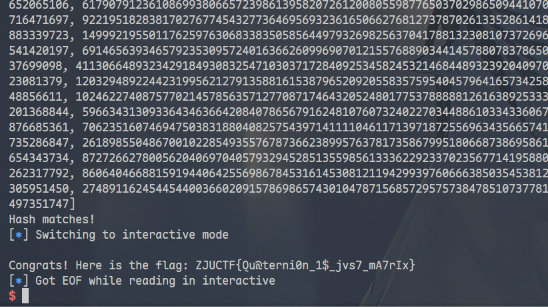
目标服务器实现了一个基于四元数的伪随机数生成器。我们获得前 6 个输出,需要预测全部 20 个输出。四元数乘法是线性的,状态更新规则 \(b_{new} = b_{old} \times a\) 可以看作线性变换。
根据 Cayley-Hamilton 定理,四元数 a 的特征多项式为 \(X^2-2\mathrm{Re}(a)X+|a|^2=0\) ;这意味着序列中的每一项(包括输出的第三分量)都满足二阶线性递推关系:
$$ x_{k+2}\equiv T\cdot x_{k+1}-N\cdot x_k\quad(\mathrm{mod~}p) $$ 其中 \(T=2\mathrm{Re}(a),N=|a|^2\) 。
从递推关系出发,对于任意连续的 5 个输出 \(x_0, x_1, x_2, x_3, x_4\):
同时:
两式相等意味着:
进而有:
我们可以计算多个这样的差值,它们都是 p 的倍数。通过计算这些差值的最大公约数,可以恢复出 p 的倍数。由于 p 是强素数,我们还需要去除结果中的小因子以得到真正的 p,进而得到 T, N。
from pwn import *
import hashlib
import itertools
from Crypto.Util.number import GCD, inverse, isPrime
import string

context.log_level = 'debug'

def PoW(prefix, digest):
    import itertools
    print(f"Solving PoW: sha256(XXXX + {prefix}) == {digest}")
    chars = string.ascii_letters + string.digits
    for x in itertools.product(chars, repeat=4):
        s = "".join(x)
        if sha256((s + prefix).encode()).hexdigest() == digest:
            print(f"Found: {s}")
            return s
    return None

r = remote('127.0.0.1', 11996)
resp = r.recvline().decode().strip()
print(f"PoW Challenge: {resp}")
prefix_part = "sha256(XXXX + "
if prefix_part in resp:
    prefix = resp.split(prefix_part)[1].split(')')[0]
    digest = resp.split('== ')[1]
else:
    print("Unknown PoW format")
    return

r.recvuntil(b"Give me XXXX:")
prefix = POW(prefix, digest)
if not prefix:
    print("PoW failed")
    exit(0)
r.send(prefix.encode())
# Wait for start of BANNER
r.recv(1)
r.sen
known = None
while True:
    line = r.recvline().decode().strip()
    if not line: continue
    if line.startswith('['):
        known = eval(line)
        break
print(f"Known: {known}")
hint = r.recvline().decode().strip()
print(f"Hint: {hint}")

x = known
diffs = []

# x[k+2] = T * x[k+1] - N * x[k] mod p
# T = (x1*x2 - x0*x3) / (x1^2 - x0*x2)

for i in range(len(x) - 4):
    x0, x1, x2, x3, x4 = x[i:i+5]

    num1 = x1 * x2 - x0 * x3
    den1 = x12 - x0 * x2

    num2 = x2 * x3 - x1 * x4
    den2 = x22 - x1 * x3

    # num1/den1 = num2/den2 mod p
    # num1*den2 - num2*den1 = 0 mod p

    val = num1 * den2 - num2 * den1
    if val != 0:
        diffs.append(abs(val))

if not diffs:
    print("Could not find p candidates")
    exit(0)
p = diffs[0]
for d in diffs[1:]:
    p = GCD(p, d)

print(f"Recovered k*p: {p}")

for small in [2, 3, 5, 7, 11, 13, 17, 19, 23, 29, 31]:
    while p % small == 0:
        p //= small

print(f"Refined p: {p}")
assert isPrime(p)
# Calculate T and N
x0, x1, x2, x3 = x[0], x[1], x[2], x[3]

try:
    den = (x12 - x0 * x2)
    inv_den = inverse(den, p)
    T = ((x1 * x2 - x0 * x3) * inv_den) % p
    N = ((T * x1 - x2) * inverse(x0, p)) % p
    print(f"T: {T}")
    print(f"N: {N}")
except Exception as e:
    print(f"Error calculating T/N: {e}")
    exit(0)
current = list(x)
while len(current) < 20:
    next_val = (T * current[-1] - N * current[-2]) % p
    current.append(next_val)

print(f"Generated: {current}")

guess_str = "".join(map(str, current))
if hashlib.sha256(guess_str.encode()).hexdigest() == hint:
    print("Hash matches!")
else:
    print("Hash mismatch!")

for val in current:
    r.recvuntil(b"guess: ")
    r.sendline(str(val).encode())

r.recvall(timeout=3)
ZJUCTF{ Qu@terni0n_1 $_jvs7_mA7rIx}
PRNG2
目标服务器实现了一个基于 CRC(循环冗余校验)的伪随机数生成器。我们获得前 8 个 64-bit 输出,需要预测全部 20 个输出。
next() 函数的核心逻辑可以分解为:
def transform(val):
    temp = (1 << 512) - 1
    v = val
    for _ in range(512):
        temp ^= v & 1
        temp = (temp >> 1) ^ (self.n & -(temp & 1))
        v >>= 1
    return temp ^ ((1 << 512) - 1)
这个函数 \(f(x)\) 满足:
- \(f(x \oplus y) = f(x) \oplus f(y)\)
- \(f(c \cdot x) = c \cdot f(x)\)
因此,\(f\) 是 GF(2) 上的线性变换。
因此 CRC 操作在 GF(2) 上是线性的。这意味着状态更新函数可以表示为矩阵乘法:
其中:
- \(S_k\) 是第 \(k\) 步的 512-bit 状态向量(在 GF(2) 上)
- \(M\) 是 \(512 \times 512\) 的转移矩阵
- \(C\) 是 512-bit 的常数向量
构造矩阵 \(M\):
- 计算常数项 \(C = f(0)\)
-
计算基向量的像:对每个基向量 \(e_i = 2^i\) (第 \(i\) 位为 1,其余为 0
) ,计算:
$\(M_i = f(2^i) \oplus C\)$其中 \(M_i\) 是矩阵 \(M\) 的第 \(i\) 列。
-
利用线性性:任意状态 \(x = \sum_{i=0}^{511} x_i \cdot 2^i\) 的像为: $\(f(x) = C \oplus \bigoplus_{i: x_i=1} M_i\)$
def get_matrix_and_constant():
    prng = PRNG_PLUS_2(64)

    C = prng.transform(0)
    M_cols = []
    for i in range(512):
        val = 1 << i
        res = prng.transform(val)
        col_val = res ^ C
        col_bits = [(col_val >> j) & 1 for j in range(512)]
        M_cols.append(col_bits)
    M = Matrix(GF(2), M_cols).transpose()
    C_vec = vector(GF(2), [(C >> j) & 1 for j in range(512)])
    return M, C_vec
定义:
$\(S_k = M \cdot S_{k-1} + C = M^{k-1} \cdot S_1 + \sum_{j=0}^{k-2} M^j \cdot C = M^{k-1} \cdot S_1 + C_{k-1}\)$ 对于第 \(k\) 个输出,我们知道 \(S_k\) 的低 64 位:
对于 \(k = 1, 2, \ldots, 8\):
更准确地说,对于每个 \(k\) 和每个 bit 位置 \(j \in [0, 63]\):
def solve_state(outputs):
    M, C = get_matrix_and_constant()
    rows = []
    rhs = []
    current_M = identity_matrix(GF(2), 512)
    current_C = vector(GF(2), 512)
    for k in range(8):
        target_val = outputs[k]
        target_bits = [(target_val >> j) & 1 for j in range(64)]
        const_bits = [current_C[j] for j in range(64)]
        for j in range(64):
            rhs.append(target_bits[j] + const_bits[j])
            rows.append(current_M[j])
        current_C = M * current_C + C
        current_M = M * current_M
    A_sys = Matrix(GF(2), rows)
    B_sys = vector(GF(2), rhs)
    print(f"System size: {A_sys.nrows()} x {A_sys.ncols()}")
    print(f"System rank: {A_sys.rank()}")
    try:
        solution = A_sys.solve_right(B_sys)
        s1_int = 0
        for i in range(512):
            if solution[i] == 1:
                s1_int |= (1 << i)
        kernel = A_sys.right_kernel()
        print(f"Kernel dimension: {kernel.dimension()}")
        candidates = [s1_int]
        if kernel.dimension() > 0:
            basis = kernel.basis()
            import itertools
            for coeffs in itertools.product([0, 1], repeat=kernel.dimension()):
                if all(c == 0 for c in coeffs): continue
                diff = vector(GF(2), 512)
                for i, c in enumerate(coeffs):
                    if c == 1:
                        diff += basis[i]
                new_sol = solution + diff
                cand_int = 0
                for i in range(512):
                    if new_sol[i] == 1:
                        cand_int |= (1 << i)
                candidates.append(cand_int)
        return candidates
    except ValueError:
        print("No solution found")
        return []
完整解题代码:
from sage.all import *
from pwn import *
from hashlib import sha256
import string

context.log_level = 'debug'

class PRNG_PLUS_2(object):
    """
    copy from prng_plus.py
    """
    pass

def get_matrix_and_constant():
    prng = PRNG_PLUS_2(64)

    C = prng.transform(0)
    M_cols = []
    for i in range(512):
        val = 1 << i
        res = prng.transform(val)
        col_val = res ^ C
        col_bits = [(col_val >> j) & 1 for j in range(512)]
        M_cols.append(col_bits)
    M = Matrix(GF(2), M_cols).transpose()
    C_vec = vector(GF(2), [(C >> j) & 1 for j in range(512)])
    return M, C_vec

def solve_state(outputs):
    M, C = get_matrix_and_constant()
    rows = []
    rhs = []
    current_M = identity_matrix(GF(2), 512)
    current_C = vector(GF(2), 512)
    for k in range(8):
        target_val = outputs[k]
        target_bits = [(target_val >> j) & 1 for j in range(64)]
        const_bits = [current_C[j] for j in range(64)]
        for j in range(64):
            rhs.append(target_bits[j] + const_bits[j])
            rows.append(current_M[j])
        current_C = M * current_C + C
        current_M = M * current_M
    A_sys = Matrix(GF(2), rows)
    B_sys = vector(GF(2), rhs)
    print(f"System size: {A_sys.nrows()} x {A_sys.ncols()}")
    print(f"System rank: {A_sys.rank()}")
    try:
        solution = A_sys.solve_right(B_sys)
        s1_int = 0
        for i in range(512):
            if solution[i] == 1:
                s1_int |= (1 << i)
        kernel = A_sys.right_kernel()
        print(f"Kernel dimension: {kernel.dimension()}")
        candidates = [s1_int]
        if kernel.dimension() > 0:
            basis = kernel.basis()
            import itertools
            for coeffs in itertools.product([0, 1], repeat=kernel.dimension()):
                if all(c == 0 for c in coeffs): continue
                diff = vector(GF(2), 512)
                for i, c in enumerate(coeffs):
                    if c == 1:
                        diff += basis[i]
                new_sol = solution + diff
                cand_int = 0
                for i in range(512):
                    if new_sol[i] == 1:
                        cand_int |= (1 << i)
                candidates.append(cand_int)
        return candidates
    except ValueError:
        print("No solution found")
        return []

def PoW(prefix, digest):
    import itertools
    print(f"Solving PoW: sha256(XXXX + {prefix}) == {digest}")
    chars = string.ascii_letters + string.digits
    for x in itertools.product(chars, repeat=4):
        s = "".join(x)
        if sha256((s + prefix).encode()).hexdigest() == digest:
            print(f"Found: {s}")
            return s
    return None

r = remote('127.0.0.1', 4078)
line = r.recvline().decode().strip()
if "sha256" in line:
    parts = line.split()
    suffix = parts[2][:-1]
    digest = parts[4]
    ans = PoW(suffix, digest)
    r.sendlineafter(b"Give me XXXX:", ans.encode())
r.recvuntil(b"Level: ")
r.sendline(b"2")

line = r.recvline().decode().strip()
if not line:
    line = r.recvline().decode().strip()

known = eval(line)
print(f"Known outputs: {known}")

# Receive hint
hint = r.recvline().decode().strip()
print(f"Hint: {hint}")

# Solve
print("Solving for state...")
candidates = solve_state(known)
print(f"Found {len(candidates)} candidates")

correct_outputs = None

for s1_cand in candidates:
    prng_rec = PRNG_PLUS_2(64)
    prng_rec.a = s1_cand

    rec_outputs = [known[0]]
    for _ in range(19):
        rec_outputs.append(prng_rec.next())

    # Check hint
    rec_hint = sha256("".join(map(str, rec_outputs)).encode()).hexdigest()
    if rec_hint == hint:
        print("Found correct state!")
        correct_outputs = rec_outputs
        break

if correct_outputs:

    for i in range(20):
        r.recvuntil(b"guess: ")
        r.sendline(str(correct_outputs[i]).encode())

    r.interactive()
else:
    print("Failed to recover state matching hint.")
    r.close()
(忘记截图了)
ZJUCTF{ U_@irEad1_kn0w_CRC_1s_lIneaR }
easy_poly
- 需要恢复 32 个系数,每个系数约 32 bits,总共约 1024 bits 的信息
- 每次查询只能得到 \(f(x) \pmod m\) ,且 m 不可重复
sage: total_info_bit = 0
sage: for p in primes(750):
....:     total_info_bit += p.bit_length()
sage: total_info_bit
1097
理论上我们可以获得 1097 bits 的信息,可行,尝试 LLL;格能够找到解,但是会时间过长,服务器只给我们 10 s。
尝试降维:
- 恢复 \(a_0\)
- 使用最小的若干个素数,查询点 \(x=0\)
- 此时 \(f(0) = a_0\)
- 通过 CRT 恢复 \(a_0\)
- 对于 \(a_{31}\),我们猜测其高 \(k\) 位:
- \(a_{31} = (\text{guess} \ll (32-k)) + a_{31\_\text{low}}\)
- 在权衡猜测次数和 LLL 求解用时的乘积后,选择 k=4
调整后的方程:
对于 31 个未知数(\(a_1, \ldots, a_{30}, a_{31\_\text{low}}\)
其中:
- \(W = 2^{100}\),约束最后一列为 0
- \(C_i\):CRT 预计算的常数
- \(M = \prod m_j\):模数乘积
- \(Y'\):调整后的目标值(将 \(a_i \in [0, p)\) 映射到 \([-p/2, p/2)\),减小目标向量的范数)
from sage.all import *
from pwn import *
import time

context.log_level = 'debug'
primes_list = list(primes(750))
io = remote('127.0.0.1', 12719)
# Get p
io.recvuntil(b"p = ")
p_val = int(io.recvline().strip())
log.info(f"p = {p_val}")

# Recover a0
p_prod = 1
primes_for_a0 = []
idx = 0
while p_prod <= p_val and idx < len(primes_list):
    m = primes_list[idx]
    p_prod *= m
    primes_for_a0.append(m)
    idx += 1

remaining_primes = primes_list[idx:]
log.info(f"Using {len(primes_for_a0)} primes for a0 recovery.")

payload = ""

# Queries for a0 (x=0)
for m in primes_for_a0:
    payload += f"1\n{m}\n0\n"

# Queries for lattice (random x)
lattice_queries = []
for m in remaining_primes:
    x = randint(0, m-1)
    lattice_queries.append((m, x))
    payload += f"1\n{m}\n{x}\n"

log.info(f"Sending {len(primes_for_a0) + len(lattice_queries)} queries...")
io.send(payload)

# For a0
a0_residues = []
for _ in primes_for_a0:
    io.recvuntil(b"result = ")
    res = int(io.recvline().strip())
    a0_residues.append(res)

a0_recovered = CRT_list(a0_residues, primes_for_a0)
log.info(f"Recovered a0: {a0_recovered}")

# For lattice
results = []
moduli = []
x_vals = []
for m, x in lattice_queries:
    io.recvuntil(b"result = ")
    res = int(io.recvline().strip())
    results.append(res)
    moduli.append(m)
    x_vals.append(x)

log.info("Received all results.")

# We want a1...a31
# sum_{i=1}^{31} a_i x^i = Y - a_0

C = []
for k in range(1, 32):
    residues = [pow(int(x_val), int(k), int(m)) for m, x_val in zip(moduli, x_vals)]
    c_val = CRT_list(residues, moduli)
    C.append(c_val)

M = prod(moduli)
log.info(f"Modulus size: {M.nbits()} bits")

Y_raw = CRT_list(results, moduli)
Y = (Y_raw - a0_recovered) % M

# Guess top bits of a31
bits_to_guess = 4
guess_limit = 1 << bits_to_guess
shift_amount = 32 - bits_to_guess

# Centering shifts
# a1..a30: p//2
# a31_low: (1<<shift_amount)//2
shifts = [p_val // 2] * 30 + [(1 << shift_amount) // 2]

# Base Matrix
dim = 33 # 30 vars (a1..a30) + 1 var (a31_low) + 1 modulus + 1 embedding
W = 2100
mat = Matrix(ZZ, dim, dim)

# a1..a30
for i in range(30):
    mat[i, i] = 1
    mat[i, 32] = W * C[i]

# a31_low
mat[30, 30] = 1
mat[30, 32] = W * C[30] # C[30] corresponds to x^31

mat[31, 32] = W * M
mat[32, 31] = 1

log.info(f"Iterating {guess_limit} guesses...")

for guess in range(guess_limit):
    # Adjust Y for guess
    # a31 = guess << shift + low
    # term = (guess << shift) * x^31 + low * x^31
    # We move known part to RHS

    term_known = (guess << shift_amount) * C[30] # C[30] is x^31
    Y_adjusted = (Y - term_known) % M

    # Centering correction
    shift_correction = sum(s * c for s, c in zip(shifts, C))
    Y_prime = (Y_adjusted - shift_correction) % M

    mat[32, 32] = -W * Y_prime

    L = mat.LLL()
    # L = mat.BKZ(block_size=20)

    for row in L:
        if row[32] == 0 and abs(row[31]) == 1:
            sign = 1 if row[31] == 1 else -1

            coeffs_found_partial = []
            for i in range(30):
                coeffs_found_partial.append(sign * row[i] + shifts[i])

            a31_low = sign * row[30] + shifts[30]
            a31_found = (guess << shift_amount) + a31_low

            coeffs_found = [a0_recovered] + coeffs_found_partial + [a31_found]

            if all(0 <= c < p_val for c in coeffs_found):
                log.info(f"Found candidate with guess {guess}")

                # Send answer
                payload_ans = "2\n" + " ".join(str(c) for c in coeffs_found) + "\n"
                io.send(payload_ans)

                # Check response
                try:
                    resp = io.recvline(timeout=1)
                    if b"Correct" in resp:
                        log.success(f"Flag: {resp}")
                        print(resp.decode())
                        io.interactive()
                        exit(0)
                    else:
                        log.warning("Wrong answer")
                except:
                    pass

print("Failed to find coefficients")

ZJUCTF{16d75376-87e4-4e55-b4b2-b370c6ddef46}
curve2
给定一个在 \(\mathbb{F}_p\) 上的超椭圆曲线(\(p\) 随机
- 题目没有给出 \(f(x)\),但给出了 Jacobian 群上的点 \(D\) 和 \(D_2\)。在 Mumford 表示法中,点 \(D\) 由多项式对 \((u, v)\) 表示,满足 \(f(x) \equiv v(x)^2 \pmod{u(x)}\)。我们可以收集几轮的 \(D_2\) 点,利用多项式中国剩余定理(CRT)恢复出 \(f(x)\)
- 恢复 \(f(x)\) 后,利用 SageMath 的
HyperellipticCurve(f).jacobian().polynomial()可以计算出 Jacobian 群的阶 \(N\) - 由于 \(k\) 是 16 位素数(小于 65536
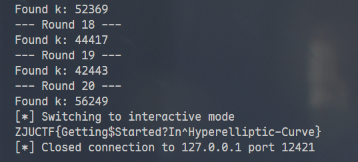
) ,我们可以预先计算所有可能的 \(k \cdot D\) 并存入哈希表,空间换时间 - 对于每一轮,通过查表找到 \(k\),然后计算 \(k_2 = k^{-1} \pmod{N}\) 并发送。
from pwn import remote
from sage.all import *
import re

def parse_jacobian_point(s, R):
    s = s.strip('()')
    u_str, v_str = s.split(', ')
    u = R(u_str)
    v = R(0)
    if 'y' in v_str:
        v_part = v_str.replace('y', '').strip()
        if v_part:
            v = -R(v_part)
    return u, v

io = remote('127.0.0.1', 12421)
io.recvuntil(b'p=')
p = int(io.recvline().strip())
R = PolynomialRing(GF(p), 'x')
io.recvuntil(b'D=')

D_str = io.recvline().strip().decode()
u_D, v_D = parse_jacobian_point(D_str, R)
io.recvuntil(b'D2=')
D2_str1 = io.recvline().strip().decode()
io.sendlineafter(b'k2=', b'1')
io.recvuntil(b'D2=')
D2_str2 = io.recvline().strip().decode()
u_D2_1, v_D2_1 = parse_jacobian_point(D2_str1, R)
u_D2_2, v_D2_2 = parse_jacobian_point(D2_str2, R)
us = [u_D, u_D2_1, u_D2_2]
vs = [v_D, v_D2_1, v_D2_2]
f = CRT([v2 for v in vs], us)

H = HyperellipticCurve(f)
J = H.jacobian()(GF(p))
D = J([u_D, v_D])

primes = [i for i in range(215, 216) if is_prime(i)]
table = {str(k * D): k for k in primes}

for _ in range(19):
    io.recvuntil(b'D2=')
    D2_str = io.recvline().strip().decode()
    u_D2, v_D2 = parse_jacobian_point(D2_str, R)
    D2 = J([u_D2, v_D2])
    k = table.get(str(D2))
    if k is None:
        io.sendlineafter(b'k2=', b'1')
    else:
        order = H.frobenius_polynomial()(1)
        k2 = inverse_mod(k, order)
        io.sendlineafter(b'k2=', str(k2).encode())

io.recvall(timeout=3)
ZJUCTF{Getting$Started?In^Hyperelliptic-Curve}